Building Orientation and Solar Studies
Understanding Building Orientation
What Building Orientation Means in Architectural Design
Building orientation refers to the way a building is positioned on its site in relation to the sun path, the north direction, prevailing winds, surrounding structures, vegetation, and the broader climatic environment. It is one of the earliest and most influential decisions in architectural planning because it directly affects indoor comfort, daylight distribution, ventilation quality, shadow formation, and long-term energy performance. A building that is correctly oriented responds naturally to environmental conditions and reduces the need for mechanical cooling or heating systems.
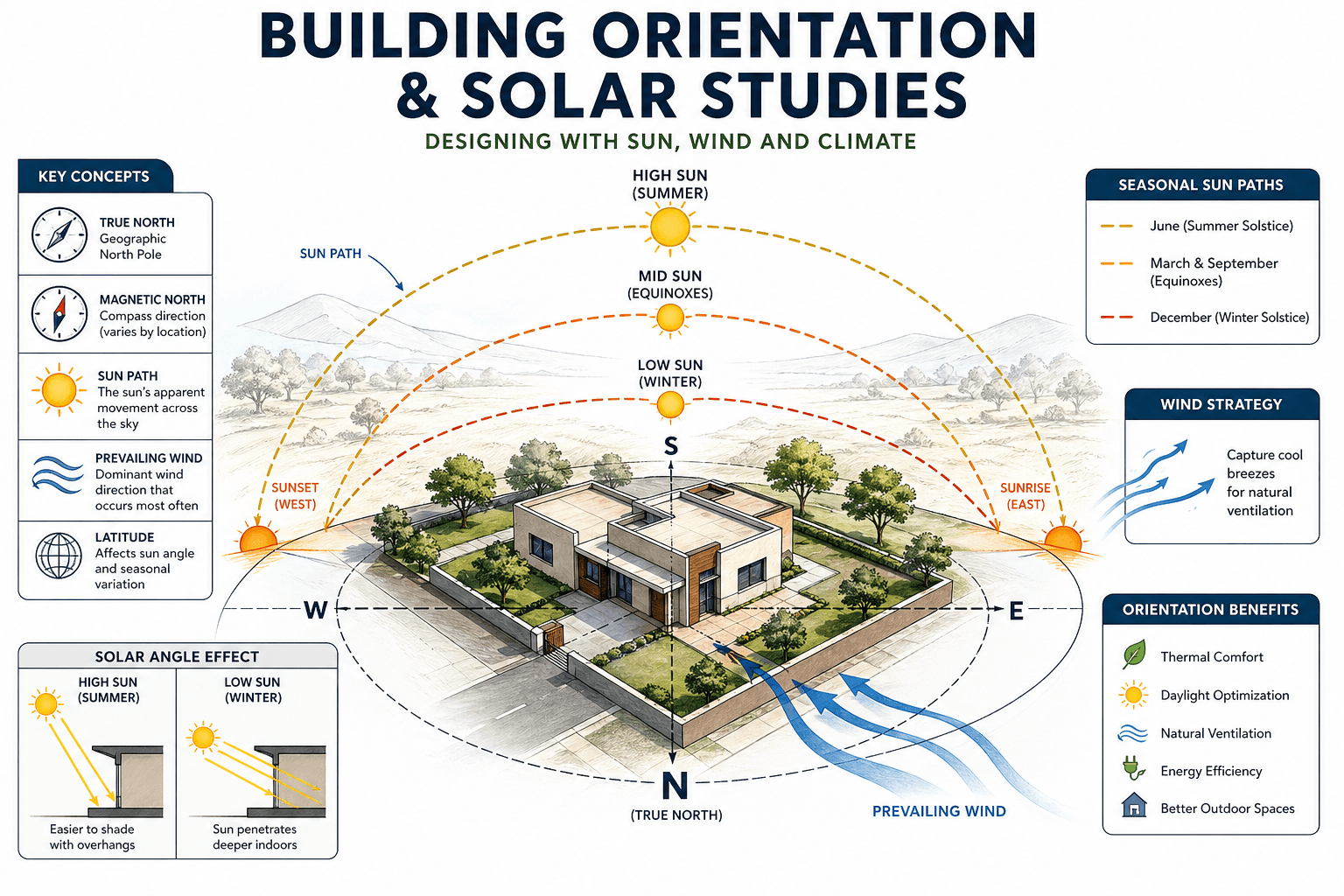
Orientation is not simply about rotating a building to face a particular direction. It is a process of understanding how environmental forces interact with the building throughout the day and across the seasons. Designers study how sunlight strikes different façades, how wind moves across the site, and how outdoor spaces will be used at different times. These observations allow the building to work with its environment instead of against it.

Why Orientation Is a Primary Design Decision
Before selecting window sizes, façade treatments, or shading devices, architects first determine how the building should sit on the land. Orientation influences how daylight enters interior spaces, how heat accumulates or dissipates across walls and roofs, how air flows through rooms, and how outdoor areas remain comfortable during different times of the day. Because of these impacts, orientation is not a secondary adjustment made after planning; it is a foundational decision that shapes the overall performance of the building.

A well-oriented building can reduce overheating in warm climates, improve solar heat gain in cooler climates, support cross ventilation, and create pleasant outdoor living areas. These benefits make orientation one of the most important tools available to designers working in residential environments.
Understanding North in Architectural Practice
True North as the Primary Reference Direction
Architectural orientation begins with identifying true north, which is the geographic direction toward the Earth’s North Pole. True north provides a stable reference for analyzing solar movement and shadow direction because the sun’s apparent path across the sky is measured relative to this fixed direction. For this reason, site plans and architectural drawings commonly include a north arrow that indicates the orientation of the building on the site.
When designers understand the position of true north, they can predict which façades will receive morning sunlight, which will receive afternoon exposure, and which will experience more balanced daylight conditions throughout the year. This understanding allows solar studies to become accurate and meaningful.
Magnetic North and Its Practical Role
Magnetic north is the direction indicated by a compass and is influenced by the Earth’s magnetic field. Because this magnetic direction shifts slightly depending on geographic location and changes slowly over time, it does not always coincide exactly with true north. Magnetic north remains useful in surveying and field positioning, but true north is generally preferred for solar analysis because it reflects the actual relationship between the building and the movement of the sun.
Understanding the difference between these two reference directions helps ensure that orientation studies remain precise and reliable.
The Sun Path and Its Influence on Buildings
Daily Solar Movement Around a Building
The sun rises approximately from the east, moves across the sky during the day, and sets toward the west. Because of this movement, different façades of a building receive sunlight at different times. East-facing walls receive morning sunlight that is generally shorter in duration, while west-facing walls receive afternoon sunlight that often lasts longer and may contribute more strongly to indoor heat accumulation in many climates. Roof surfaces and upper façades may also receive direct exposure depending on building height and slope conditions.
Understanding this daily solar movement allows designers to anticipate how daylight enters rooms and where shading devices may be necessary to maintain comfort.
Seasonal Solar Variation Across the Year
The position of the sun in the sky changes throughout the year, and this seasonal variation affects the depth and angle of sunlight entering buildings. In many regions, the sun appears higher in the sky during warmer periods and lower during cooler periods. These differences influence how shadows are cast, how deeply sunlight penetrates interior spaces, and how façades respond to seasonal exposure conditions.
Because solar conditions are not constant across the year, architects study sunlight behavior during multiple seasons when determining building orientation. This approach helps ensure that the building performs well under changing environmental conditions rather than responding only to a single moment in time.
Solar Studies in Architectural Design
What a Solar Study Is and Why It Matters
A solar study is the process of analyzing how sunlight interacts with a building and its surroundings at different times of day and during different periods of the year. Through solar studies, designers identify which façades receive the strongest solar exposure, where shading should be introduced, and how daylight can be used effectively inside the building. Solar studies also help determine how outdoor spaces such as terraces, courtyards, and entrances will behave under changing sunlight conditions.
These analyses allow architects to make informed decisions about window placement, façade articulation, shading strategies, and outdoor layout before construction begins.
Manual and Digital Solar Study Methods
Solar studies can be carried out using both hand drawing techniques and digital simulations. Manual solar diagrams typically begin with a site outline and a clearly marked true north direction. Designers then sketch the path of the sun across the sky for morning, midday, and afternoon conditions, indicating the direction of sunlight using colored pencils and representing shadow zones with tonal shading. Repeating these diagrams for different seasonal conditions allows learners to visualize changes in solar exposure directly.
Digital solar simulations can also be produced using most modern architectural software platforms. These tools allow designers to study hourly sunlight movement, seasonal shadow patterns, and façade exposure conditions with greater precision. Whether manual or digital, the purpose of solar studies remains the same: to guide orientation decisions before the building form becomes fixed.
Hemisphere and Latitude in Solar Orientation
Understanding Hemisphere Effects on Sun Position
The Earth is divided into the northern hemisphere and the southern hemisphere, and the apparent movement of the sun differs between them. Because of this difference, the direction from which the strongest sunlight arrives is not identical everywhere. A façade that receives strong solar exposure in one hemisphere may behave differently in another. Designers must therefore understand which hemisphere the project site belongs to before making orientation decisions.
This awareness ensures that solar strategies remain appropriate to the building’s geographic context.
The Role of Latitude in Solar Angle Variation
Latitude describes the distance of a location north or south of the equator and strongly influences the height of the sun in the sky and the extent of seasonal variation in daylight conditions. Locations closer to the equator often experience more direct overhead sunlight and smaller differences between seasons, while locations farther from the equator experience larger seasonal changes in solar angle and day length.
Understanding latitude allows designers to predict how deeply sunlight will penetrate into rooms and how strongly façades will be exposed at different times of the year.
Prevailing Winds and Orientation Strategy in Africa
Coastal Wind Conditions Across African Regions
In many coastal areas of Africa, airflow patterns are influenced by temperature differences between land and ocean surfaces. Moist breezes moving inland from the ocean during certain seasons can provide valuable cooling effects when buildings are oriented to receive them. Positioning openings to capture these breezes improves indoor comfort and strengthens natural ventilation performance.
These coastal wind patterns are particularly important in tropical regions where passive cooling strategies play a major role in residential comfort.
Inland and Seasonal Wind Systems
Inland regions across the savannah and Sahel zones experience different wind behavior influenced by seasonal atmospheric systems. Winds such as the Harmattan, which travels from the northeast during dry periods, affect temperature conditions, air quality, and visibility. In eastern Africa, seasonal wind patterns are influenced by the Indian Ocean, while southern Africa experiences varied wind behavior shaped by terrain and regional climate systems.
Because wind conditions vary significantly across the continent, designers must always study local seasonal wind behavior rather than assuming a single continental pattern.
Balancing Sunlight and Wind in Site Orientation
Integrating Solar Exposure and Natural Ventilation
Good building orientation requires balancing solar exposure and natural ventilation rather than prioritizing only one environmental factor. A façade that receives strong daylight may also receive excessive heat, while a façade that captures useful breezes may require additional shading protection. Designers therefore study both sun movement and wind direction together before deciding how the building should be positioned on the site.
This integrated approach improves indoor comfort and reduces reliance on mechanical environmental control systems.
Responding to Surrounding Site Conditions
Orientation decisions must also respond to surrounding buildings, vegetation, topography, access routes, privacy needs, and outdoor activity zones. A terrace that receives abundant daylight may still become uncomfortable if exposed to strong afternoon sun without protection. Similarly, windows that admit generous daylight may create overheating if shading devices are not included.
For this reason, orientation is always considered together with site context rather than as an isolated environmental factor.
Shading as a Companion to Orientation
Why Orientation Alone Is Not Enough
Even when a building faces a favorable direction, excessive solar heat may still enter interior spaces if shading devices are not properly designed. Orientation and shading therefore work together as complementary strategies. Architectural elements such as roof overhangs, recessed windows, balconies, verandas, vertical fins, and vegetation screens help reduce unwanted solar gain while preserving useful daylight.
Through these strategies, designers can maintain comfort even when façade exposure conditions are strong.
Designing Comfortable Outdoor Spaces Through Orientation
Outdoor spaces such as courtyards, terraces, and entrances benefit greatly from careful orientation planning. A space that receives balanced daylight and partial shading remains usable throughout the day, while one exposed to strong afternoon sunlight may become uncomfortable despite its openness. Solar studies help determine where these outdoor areas should be placed so they remain functional and pleasant under changing sunlight conditions.
Practical Beginner Workflow for Solar Study Sketching
Step-by-Step Manual Solar Diagram Method
Designers and drafters can begin solar studies immediately using simple drawing tools. A typical manual method begins by sketching the site boundary and marking true north clearly on the drawing. The path of the sun from east to west can then be represented using curved directional lines that indicate morning, midday, and afternoon sunlight. Shadow zones can be suggested using tonal shading to show where sunlight will be blocked by building elements.
Repeating this process for different seasonal conditions helps learners understand how façade exposure changes across the year and strengthens their ability to make informed orientation decisions.
Developing Orientation Awareness Through Repetition
Regular practice with solar diagrams improves understanding of façade exposure, shadow movement, and daylight distribution across buildings and sites. Over time, designers begin to anticipate how sunlight behaves without needing complex calculations. This growing awareness allows orientation decisions to become more intuitive and more effective during early design stages.
Orientation as a Foundation of Climate-Responsive Design
Improving Comfort Through Environmental Awareness
Building orientation connects solar exposure, ventilation potential, shading strategy, and site response into one coordinated environmental system. When handled correctly, it improves indoor comfort naturally and reduces dependence on artificial cooling or heating systems.
Designers who understand orientation early in the planning process create buildings that respond intelligently to their environment.
Supporting Long-Term Energy Efficiency
Because orientation affects daylight availability, cooling demand, and heating conditions, it plays a major role in long-term building performance. Careful orientation improves sustainability without increasing construction complexity and helps create residential environments that remain comfortable throughout the year.
For architectural designers and drafters, mastering building orientation and solar studies is therefore one of the most important early skills in climate-responsive residential design.