Residential Interior Space Planning
Residential interior space planning is the disciplined process of arranging rooms, circulation paths, furniture, storage, openings, and technical services inside a house so that everyday life becomes efficient, comfortable, safe, and pleasant. It is not merely the act of dividing a building into labeled spaces. It is the art and science of deciding how people will enter the home, where they will sit, eat, sleep, cook, wash, store belongings, move from room to room, enjoy privacy, receive natural light, and live without unnecessary inconvenience.
A well-planned interior reduces wasted area, improves comfort, supports good ventilation and daylight, protects quiet spaces from noise, and allows the house to remain useful over many years.

A residential plan must therefore be understood as a living system. Each room affects other rooms. The position of a kitchen influences the dining room. The location of the living room affects privacy. The placement of corridors affects circulation quality. The size of windows affects light, ventilation, and even furniture layout. The position of the staircase affects the organization of both lower and upper floors. Good interior planning is achieved when all of these parts support one another. When the layout is weak, daily life becomes frustrating even if the house appears attractive on paper. When the layout is strong, the house feels intuitive, calm, and well organized.
Interior Zoning: Functional Organization of Residential Space
The clearest way to understand residential planning is to divide the house into three major interior zones: the public zone, the private zone, and the service zone. A zone is a group of spaces that share a similar level of access, privacy, and function. This way of organizing the house helps the designer control movement, privacy, sound, and domestic order.
The public zone is the part of the house that receives visitors. It usually includes the entrance, foyer, living room, dining room, and guest toilet. These rooms should normally be near the main entrance so that visitors do not need to pass through the sleeping quarters of the house.
The private zone is the part of the house mainly reserved for residents. It includes bedrooms, dressing spaces, family bathrooms, and often a family lounge. This zone should feel quieter, more protected, and less exposed to visitor circulation.
The service zone contains the working rooms of the house. It usually includes the kitchen, pantry, laundry, utility room, storage rooms, and sometimes technical spaces. This zone must connect efficiently to the public and private parts of the house without disturbing either one.
When these zones are properly arranged, the house feels orderly. When they are badly mixed, the house loses comfort and dignity. A visitor should not have direct visual access to sleeping spaces. A laundry should not dominate a formal entrance. A kitchen should not be so isolated that serving food becomes inconvenient. A bedroom should not be positioned where it is constantly affected by social noise.
The Entrance, Foyer, and Arrival Interior
The entrance is the point where one passes from outside into the house. It is more than just a door in a wall. It is the beginning of the interior experience. The entrance should help organize arrival, create a first impression, and provide orientation.
A foyer is a small entrance space or lobby immediately inside the main door. Some designers may also know it as an entrance hall. Its role is to create transition between the exterior and the interior. A foyer helps control privacy, because the whole house is not exposed the moment the door opens. It also helps with circulation, because it can direct people toward the living room, guest toilet, stairs, or other parts of the house in a clear manner.

A foyer may be modest in size, often around 2 square meters to 6 square meters, but even a small one can improve the quality of the plan significantly. In warm climates, it can also reduce dust and heat movement from outside. In more formal homes, the foyer may act as a visual control point, revealing selected views while hiding private areas. The entrance should ideally not open directly into a bedroom corridor. It should also avoid exposing the entire living room and dining room in one glance unless that openness is a deliberate design intention.
The Living Room and the Main Social Space
The living room is the principal social room of the house. It is the space used for receiving guests, sitting, relaxing, talking, and often watching television. In some homes it is highly formal. In others it is mixed with family life. Its planning must therefore respond to both furniture arrangement and circulation.

A living room is not successful simply because it is large. Its shape, width, furniture grouping, television wall, opening positions, and movement paths all matter. In many medium-size houses, living rooms often range from 25 square meters to 40 square meters, though smaller and larger examples also exist depending on the scale of the home. A useful width for comfortable furniture arrangement often begins around 3.6 meters and may extend to 5.5 meters or more depending on the room type.
The seating arrangement should be planned before the walls are finalized. A sofa set, armchairs, coffee table, television unit, occasional tables, shelves, and circulation clearances should all be considered together. Circulation should not cut across the middle of the main conversation area if that can be avoided. It is better when people can move along the edge of the room rather than constantly passing between sofas and the television.

In relation to other rooms, the living room usually connects naturally to the entrance, dining space, and sometimes a terrace or veranda. In many homes it should not be a thoroughfare to bedrooms. If every movement in the house crosses the living room, the social space loses comfort. The living room should also be planned with light control in mind. Large openings may bring in wonderful daylight, but glare on the television wall and overheating from harsh sun must be controlled by orientation, overhangs, curtains, shading devices, or thoughtful glazing choices.
The Family Lounge and Secondary Living Space
A family lounge is a more private sitting room mainly used by the residents of the house rather than visitors. It is often less formal than the main living room. It may hold television watching, children’s activities, homework, relaxed evening use, and everyday family interaction.

The family lounge is especially useful in larger houses because it reduces pressure on the formal living room. It can be placed near the bedroom zone so that the private side of family life is not always exposed to guests. A size of about 12 square meters to 25 square meters is common depending on the scale of the home and the number of users. Its furniture may include smaller sofas, a television unit, storage, bookshelves, and sometimes a study corner.
This room should not be confused with the main living room. The living room is often the public social space, while the family lounge is usually a semi-private or private social space. This distinction improves both dignity and practicality in residential planning.
The Dining Room and Eating Space
The dining room is the room or area used for eating meals, usually around a dining table and chairs. In some houses it is a separate room. In others it is part of an open plan with the living room or kitchen. Regardless of style, it must be dimensioned for real use.

A dining space is not only the table itself. It must also allow room for chairs to be pulled out and for people to move around comfortably. Dining rooms often fall in the range of 10 square meters to 20 square meters, though the actual need depends on the number of seats and the formality of use. A six-seat dining arrangement commonly benefits from a space around 2.7 meters by 3.0 meters or more once clearances are included.
A useful planning rule is to preserve approximately 750 millimeters to 900 millimeters between the table edge and walls, cabinets, or other furniture where people must sit and circulate. Larger homes may provide even more. A dining room usually relates closely to both the kitchen and the living room. If it is too far from the kitchen, serving food becomes inconvenient. If it is too exposed to kitchen clutter, the public zone loses visual calm.
When the dining area opens to a terrace or patio, it can support indoor-outdoor living very well. In such cases, the designer should think about door width, serving movement, natural light, and whether the dining zone is exposed to unwanted direct glare or heat.
The Kitchen as a Technical and Functional Core
The kitchen is the room where food is stored, washed, prepared, and cooked. It is one of the most technical rooms in the house because it combines storage, plumbing, heat, power, ventilation, hygiene, and movement. Good kitchen planning is based on workflow, not decoration alone.

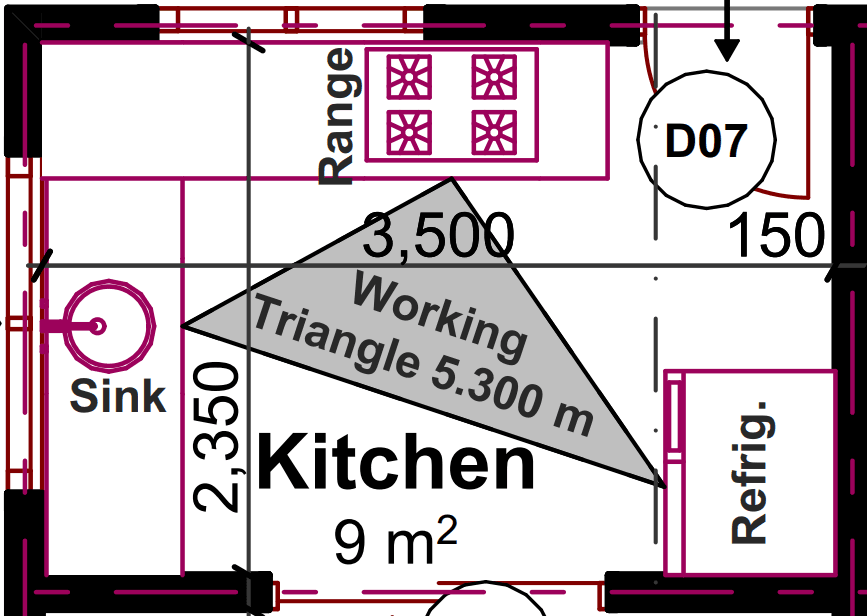
One important planning principle is the work triangle. The work triangle is the relationship between the refrigerator, the sink, and the cooker or hob. These three points form the main working circuit of the kitchen. Each side of the triangle is often around 1.2–2.7 m. The total perimeter is often around 4.0–7.9 m. The triangle should allow short and efficient movement without forcing unnecessary walking. If the points are too close, the kitchen becomes cramped. If they are too far apart, work becomes tiring and inefficient.
Kitchens often range from 10 square meters to 25 square meters depending on the house size and the chosen layout. Common kitchen layouts include the single-wall kitchen, where cabinets are placed along one wall; the galley kitchen, where two rows face each other; the L-shaped kitchen, where two walls form a corner arrangement; the U-shaped kitchen, where three sides are used; and the island kitchen, where a central work unit is added. Each type suits different house sizes and circulation conditions.
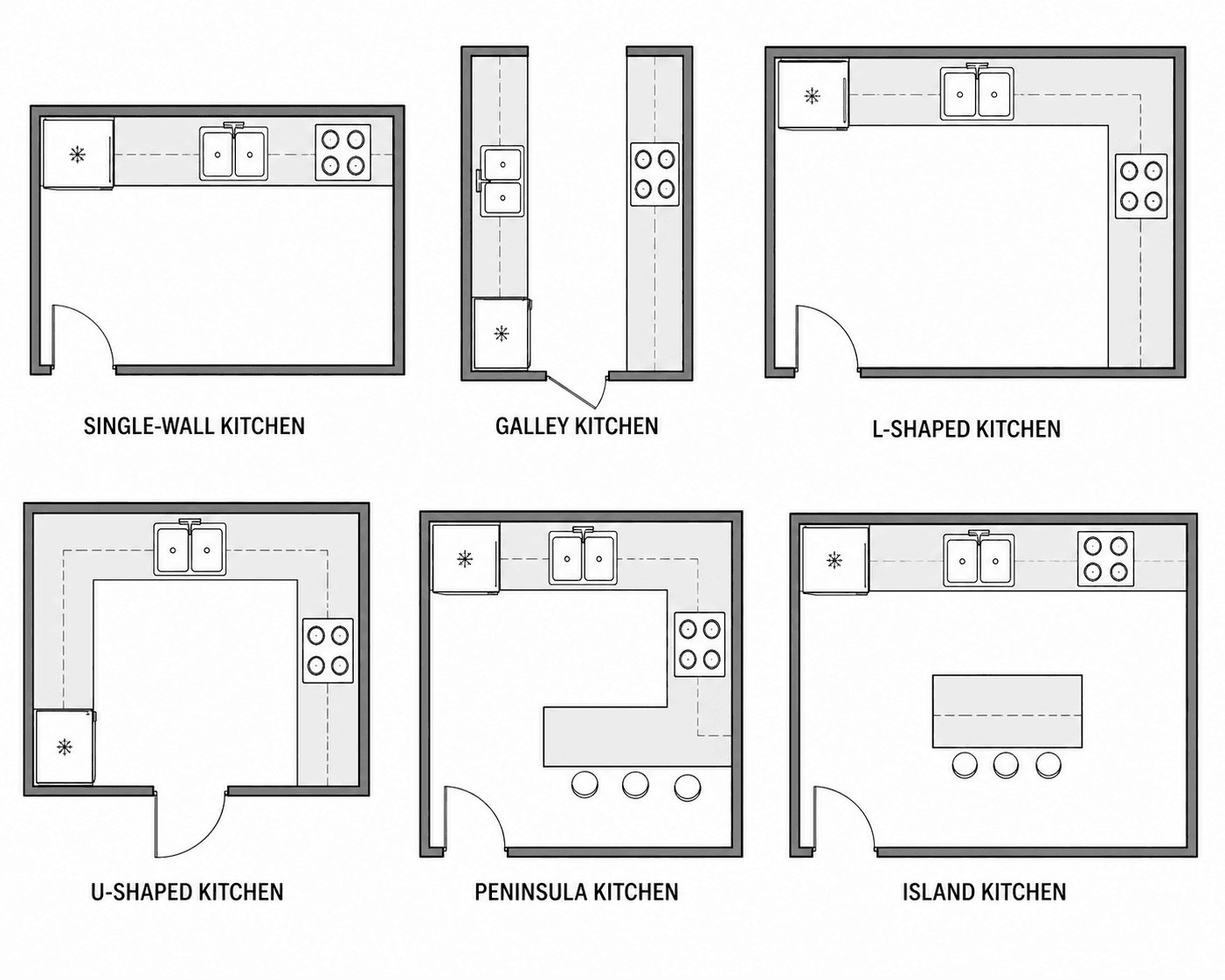
Closely related to the U-shaped arrangement is the peninsula kitchen, sometimes called a G-shaped kitchen. In this layout, a short counter projects outward from one side of the main cabinet arrangement while remaining attached at one end, creating a fourth side that partially closes the working area. Unlike an island, which stands completely separate from the walls, the peninsula remains connected to the main kitchen structure and often acts as a preparation surface, serving counter, or visual divider between the kitchen and the adjacent living space.

Countertops, also called worktops, are usually around 800 millimeters to 900 millimeters high. Circulation between two facing rows of cabinets is often about 1.0 meter to 1.2 meters at minimum, while 1.2 meters to 1.5 meters or more gives better comfort when two people work or pass each other. Storage should be planned according to use frequency. Everyday utensils should be within easy reach. The sink should have useful landing space on both sides if possible. The cooker should not be pushed into a dangerous corner where pots must cross a circulation path.

The kitchen should be near the dining room, but it does not always need to be fully exposed to it. A partial screen, sliding partition, breakfast counter, or thoughtful wall arrangement can keep convenience while controlling visual clutter. Because kitchens produce heat, grease, and moisture, they also need effective ventilation. Natural ventilation through windows helps, but cooking areas usually benefit from dedicated extract systems as well.
Pantry, Store, and Food Storage
A pantry is a small room or storage area used mainly for food, dry goods, kitchen supplies, and sometimes small appliances. It helps reduce clutter in the main kitchen and improves domestic organization.
A pantry may be modest, often around 2 square meters to 5 square meters, but it can make a major difference in functionality. Shelves should not be excessively deep, because items become difficult to find. The pantry should usually be placed close to the kitchen so that storage and retrieval are easy. In warm climates, it is beneficial when the pantry is not exposed to excessive heat and has some degree of ventilation or thermal protection.

The pantry should not be confused with a general store room. A store room may hold cleaning items, bulk household supplies, tools, or mixed equipment, while a pantry is mainly connected to food and kitchen use.
Guest Toilet and Visitor Washroom
A guest toilet is a toilet intended mainly for visitors and for use from the public zone of the house. It usually contains a toilet and washbasin and may be called a visitor washroom or powder room in some contexts.

This room should be easy for visitors to access without passing through bedrooms or private family corridors. At the same time, it should not open directly into a dining room or in a way that compromises privacy and hygiene. A separate guest toilet often ranges from 2 square meters to 3 square meters. Even when small, it should still allow comfortable door use, fixture clearance, ventilation, and cleaning.
The washbasin and toilet must be placed with usable clearances. It is not enough to make them fit physically. The room should allow a person to close the door comfortably, stand properly at the basin, and use the toilet without feeling trapped by walls or fixtures.
Corridors, Halls, and Internal Circulation
A corridor is a passage that connects rooms. A hall may be understood as a wider circulation space, distribution area, or lobby from which several rooms are reached. These spaces are essential because they shape internal movement.

Corridors commonly measure about 1.0 meter to 1.2 meters in width, while more generous or future-adaptable homes may use 1.2 meters to 1.5 meters or more. A corridor should not be narrow to the point that furniture movement becomes difficult or that two people cannot pass comfortably. Very long corridors should be avoided when possible because they consume area without creating good spatial value. It is usually better to organize related rooms around short halls or nodes rather than around one long tunnel-like corridor.
Corridors should also receive light, whether directly through windows or indirectly through borrowed light from adjacent spaces. A corridor that is technically adequate but permanently dark makes the whole house feel weak. Door positions along corridors should be checked for swing conflict. Two doors directly facing one another in a narrow corridor can become awkward if both are opened at once.
The Master Bedroom and the Main Sleeping Suite
The master bedroom is the principal bedroom of the house, usually intended for the heads of the household. When it is combined with a private bathroom and dressing area, it may be called a master suite. A suite is a group of related rooms forming one private unit.
The master bedroom should be one of the quietest rooms in the house. It should be protected from television noise, kitchen noise, laundry noise, and intense visitor circulation. In many homes it benefits from being placed on the calmer side of the plan and with more controlled privacy than the other bedrooms.

A master bedroom or suite often falls within about 25 square meters to 35 square meters, though the sleeping room itself may be smaller if dressing and bathroom areas are counted separately. The space must accommodate a bed, bedside tables, wardrobe or dressing access, circulation, and sometimes a chair, bench, television unit, or small study area. Around a double or queen bed, it is desirable to have clear movement space on the accessible sides, often around 700 millimeters to 900 millimeters or more.
The bed should not be positioned directly under a harsh air-conditioning outlet. Strong direct cold airflow on a sleeping person is uncomfortable. Window placement should provide light and ventilation without creating excessive glare on the bed or direct exposure to unwanted views.
Secondary Bedrooms, Children’s Rooms, and Guest Bedrooms
A secondary bedroom is any bedroom other than the master bedroom. It may be used by children, guests, relatives, or other household members. These rooms must not be treated as leftovers. Their planning deserves as much discipline as the principal suite.
A single bedroom is a bedroom intended for one person. A double bedroom is intended for two people, usually with one larger bed or two separate beds depending on the arrangement. In many planning standards, a single bedroom should not be too narrow to hold a bed and wardrobe properly. Useful planning benchmarks place single bedrooms around 7.5 square meters or more and double bedrooms around 11.5 square meters or more, though many comfortable homes provide more generous sizes. In broader residential design practice, secondary bedrooms often range from about 12 square meters to 20 square meters depending on use.

Children’s rooms may also need desks, book storage, toy storage, and flexible floor space. Guest rooms should be conveniently located relative to a bathroom but should not weaken family privacy. Windows, wardrobes, and door swings must all be coordinated carefully so that the room remains furnishable. A room with enough floor area but no good wall length for the bed and wardrobe is still a badly planned room.
Dressing Rooms, Wardrobes, and Storage Planning
A wardrobe is a built-in or movable storage unit for clothes, shoes, and personal items. A dressing room is a dedicated space used for clothing storage and changing. These elements are central to residential comfort.

Wardrobes are often about 600 millimeters deep, which is suitable for hanging clothes on hangers. Dressing rooms should not become narrow leftover strips. They must allow a person to move, open doors or drawers, and access clothing comfortably. The position of the wardrobe affects the entire room, because it influences bed placement, door swing, and window location.

Storage planning should be distributed throughout the house. A well-designed house does not rely on one large store room alone. Bedrooms need wardrobes. Corridors may need linen storage. Kitchens need food and utensil storage. Entrances may need coat or shoe storage. Utility rooms need shelves for cleaning items. Good storage reduces clutter and makes the whole house function better over time.
The Family Bathroom and the Ensuite
A bathroom is a room used for washing and sanitary functions. A family bathroom is shared by more than one user or bedroom. An ensuite is a bathroom directly attached to a bedroom, usually serving that bedroom privately.
Bathrooms require precise planning because multiple fixtures must work in a relatively limited area. A full bathroom often ranges from 6 square meters to 10 square meters, while a separate toilet may range from 2 square meters to 3 square meters. Typical fixtures include a washbasin, toilet, shower, and in some homes a bathtub.

A shower enclosure often benefits from dimensions around 900 millimeters by 900 millimeters or more. Clear space in front of a washbasin and toilet should be preserved so that users can stand and move comfortably. The toilet should not be squeezed tightly against a wall. Walls in selected bathrooms may be prepared so that grab bars, which are support bars for stability and accessibility, can be installed in future if needed.

Ensuites should protect privacy. It is better when the toilet is not the first element seen from the bed area. Good ventilation is essential in all bathrooms because moisture and odor must be controlled. Window ventilation is helpful, but mechanical extract may also be necessary depending on the design and construction method.
The Laundry, Utility Room, and Back-of-House Functions
A laundry room is the room used for washing, drying preparation, ironing, and clothing-related domestic work. A utility room is a service room that may contain laundry functions as well as cleaning storage, sinks, household supplies, and equipment. In some homes the two are combined.

These rooms should connect well to the kitchen, service yard, or drying area, but they should not dominate the public spaces of the house. A laundry or utility room often falls in the range of 9 square meters to 15 square meters in larger homes, although smaller versions are possible. Appliances such as washing machines and dryers need enough clear floor space for loading, unloading, servicing, and ventilation.
Because these spaces can be noisy, they should be located thoughtfully. A laundry sharing a wall with a quiet bedroom can reduce comfort. Utility rooms also need proper drainage, storage, and safe electrical planning.
The Home Office, Study, and Flexible Work Space
A home office is a room or dedicated area used for work, study, administration, reading, or computer-based tasks. Even in houses without a separate office, some form of study corner is increasingly necessary.

A small home office may begin around 6 square meters to 10 square meters, while integrated study corners require enough wall width and furniture clearances to function properly. Good work areas need daylight, but not strong glare on the screen. They also need enough power outlets, acoustic calm, and suitable wall space for desks or shelves. A study should not feel like an afterthought squeezed into a circulation route.
In some homes, the office may be placed near the entrance if occasional visitors or work-related access are expected. In other homes, it may be better placed deeper in the plan for quietness. The correct choice depends on how the room will actually be used.
The Stair and Vertical Interior Planning
A stair is the element used to move vertically between levels. It is one of the most important components in a multi-storey house because it affects circulation, safety, structure, and even the visual composition of the interior.
A stair is made up of risers and treads. The riser is the vertical face or height between one step and the next. The tread is the horizontal part on which the foot lands. In residential planning, stair risers may range broadly from about 100 millimeters to 200 millimeters, while treads may range from about 250 millimeters to 400 millimeters. Within these ranges, a combination of 150 millimeters riser and 300 millimeters tread is widely considered a comfortable proportion for everyday residential use.

The stair should not only fit. It must feel safe and pleasant to climb. Handrails are often about 900 millimeters high. Headroom should generally remain around 2.0 meters to 2.1 meters or more so that users do not feel compressed. The stair should be placed in a logical position within the house. It often works well as a hinge between public and private zones. If it is placed too close to the entrance, it may expose the upper private area too directly. If it is buried awkwardly within the service core, movement becomes inconvenient.
Natural light on or near the stair is very beneficial. A stair should not feel like a hidden dark shaft. Under-stair space may also be used for storage if headroom and access are realistic.
Lifts in Residential Interior Planning
A lift, also called an elevator, is a mechanical vertical transport system used to move people or goods between different floor levels. In most ordinary houses, the main vertical circulation element is still the stair, and many private residences do not require a lift. This is especially true for smaller one-storey and two-storey homes where movement between floors is limited and where users can reasonably rely on stairs. However, residential design should not treat lifts as irrelevant simply because they are less common in houses than in commercial or public buildings.
In real practice, some homes require or strongly benefit from a lift even when they have only two or three storeys. This usually happens for four main reasons. The first reason is accessibility, meaning that one or more occupants may be wheelchair users, may have reduced mobility, may be elderly, or may need to avoid regular stair climbing. The second reason is future-proofing, which means designing the home so that it remains usable if the occupants’ mobility changes later in life. The third reason is convenience, especially in larger residences where repeated vertical movement becomes tiring in daily life. The fourth reason is luxury and prestige, because some high-end homes include lifts as part of the quality and comfort of the residence.

A residential elevator should be positioned along the main circulation route of the house so that it connects naturally with entrance halls, corridors, and upper-floor distribution spaces. It should not open directly into bedrooms or private bathrooms, but instead into shared circulation areas where movement between floors feels logical and comfortable. In many well-planned homes, the elevator is located near the staircase so that both vertical circulation systems work together efficiently.
Typical internal cabin sizes for home elevators vary depending on manufacturer and accessibility requirements, but commonly begin around 900 millimeters to 1100 millimeters wide and 1200 millimeters to 1400 millimeters deep for compact residential models. Where wheelchair accessibility is intended, larger dimensions are required, often approaching 1100 millimeters by 1400 millimeters or more, together with adequate maneuvering space at the landing. Clear space in front of the elevator door is especially important to allow safe entry and exit.
Home elevators also influence architectural planning beyond the lift itself. They require a vertical shaft or structural opening, coordinated floor framing, electrical provision, and adequate headroom at the upper level. Because they occupy floor area on every storey they serve, their position must be carefully studied so that they support circulation rather than disrupt room layouts. Early coordination with the structural system and furniture arrangement helps avoid wasted space and awkward planning conditions.
Light, Daylight Distribution, and Room Orientation
Natural light is one of the most important elements in residential design. It affects mood, visual comfort, energy use, and the feeling of spaciousness. Daylight is the natural light that enters from the sky through openings such as windows, glazed doors, roof lights, and clerestories.

Designers should not only ask whether a room has a window. They should ask whether the room receives useful light at the right times, whether glare is controlled, whether ventilation is possible, and whether the wall positions still allow proper furniture placement. Bedrooms often benefit from softer morning light. Living rooms may need larger openings for broader daylight distribution. Kitchens require task-friendly light. Bathrooms need a balance between privacy and illumination.
A common minimum planning idea is that window area in habitable rooms may begin around 10 percent of floor area, though many designers provide more generous glazing where climate, privacy, and shading control allow it. In many quality homes, glazing may reach 15 percent, 20 percent, or sometimes more of floor area depending on orientation and the design intent. The important lesson is that the designer should not be trapped by minimums. Minimums prevent failure, but better design often goes beyond them where appropriate.
Doors, Windows, and Glazing Systems in Residential Planning
An opening is any designed void or gap in a wall, floor, roof, or partition that serves entry, light, ventilation, view, or communication. The most common openings in homes are doors and windows. Glazing refers to glass used in windows, doors, fixed panels, or other framed or frameless systems.
Doors and Their Planning Role
A door is an opening element used for passage, privacy, security, or separation. Doors affect circulation, furniture layout, privacy, ventilation, and even sound control. Common residential internal door widths often progress in increments such as 700 millimeters, 750 millimeters, 800 millimeters, 850 millimeters, 900 millimeters, and 1000 millimeters, while external doors often begin around 900 millimeters and may be wider for more generous entry.
A hinged door is the most common type. It rotates on side hinges. It is simple, familiar, and effective for most rooms. A sliding door moves sideways along a track and is useful where swing space must be saved, such as between indoor and outdoor living spaces or between room zones. A folding door is made of several linked panels and can open wide while reducing the stacking space compared with some swing systems. A pivot door rotates on a pivot point rather than side hinges and is often used for more dramatic main entrances. Each type has advantages and limitations.
Hinged doors are often preferred for bedrooms and bathrooms because they seal and provide privacy well. Sliding doors are useful where space is tight or where one wants broad openings to terraces. Folding and stacking systems are useful where the house is meant to open strongly to outdoor living. The choice should depend on function, privacy, air movement, security, weather exposure, and maintenance.
Windows and Their Functions
A window is an opening fitted with glazing and often an operable sash, used to admit daylight, air, and view. Window planning affects room atmosphere, furniture arrangement, ventilation, and facade composition. Common residential window sizes vary widely, but many standard systems are based on modular increments. Widths and heights often progress in steps such as 300 millimeters, 450 millimeters, 600 millimeters, 900 millimeters, 1200 millimeters, 1500 millimeters, 1800 millimeters, and beyond depending on the manufacturer and the design system.
Designers should understand not only size but also opening manner, meaning how the window opens. A casement window is side-hinged and opens like a door panel. It is excellent for ventilation because it can catch breeze effectively. An awning window is top-hinged and opens outward at the bottom; it can provide ventilation even in light rain and is often useful in bathrooms or kitchens. A hopper window is bottom-hinged and usually opens inward; it is less common in some residential contexts but may be used for controlled ventilation. A sliding window moves horizontally and is convenient where projecting sashes are undesirable, though it usually provides less full opening area than a casement. A fixed window does not open and is used only for light and view. A louvered window uses angled blades, often glass or metal, and is historically common in warm climates because it allows ventilation, though its sealing and security characteristics differ from tighter systems.
Casement windows are often chosen where strong natural ventilation is desired. Sliding windows are often used where simplicity, cost, or facade rhythm makes them suitable. Awning windows are useful where privacy and rain protection are important. Fixed glazing is excellent where one wants view and daylight without ventilation at that point. Louvered systems may be selected where constant airflow is prioritized, though the designer must consider water resistance, sealing, dust entry, and security.
Typical Window Area, Height, and Placement
Window planning is not only about total area. It is also about height, sill level, head level, and relation to furniture. The sill level is the height of the bottom of the window above the floor. The head level is the height of the top of the window. Low sill levels may improve view and daylight penetration but can interfere with bed heads, desks, or storage. High windows may provide privacy and deeper daylight spread, especially if combined with a high head level.
Many residential windows begin with sill heights around 600 millimeters, 750 millimeters, 900 millimeters, or 1050 millimeters depending on room function. Lower sill levels are common where seated views are desirable, such as in living rooms. Higher sill levels are often useful in bedrooms, bathrooms, or where furniture must fit below the opening. Head levels frequently align with door heads or structural lintels, often around 2100 millimeters, 2400 millimeters, or higher depending on ceiling height and architectural style.
Generous designers do not always stop at minimum window area ratios. If privacy, shading, and thermal performance are managed properly, more glazing may significantly improve the quality of a room. However, more glazing is not automatically better. Excessive unprotected glass can cause glare, overheating, and furniture-placement problems. Good design balances daylight, view, privacy, ventilation, and heat control.
Glazing Material and Frame Choice
Glazing systems also differ by material and performance. Common frame materials include timber, aluminum, uPVC, and steel in some cases. Timber can offer warmth and good appearance but requires maintenance. Aluminum is durable, slim, and widely used, but thermal performance must be considered. uPVC can provide good sealing and lower maintenance in some markets. Steel gives strength and fine profiles but may be more expensive and can require careful corrosion protection.

Glass may be clear, tinted, frosted, laminated, tempered, double-glazed, or otherwise treated depending on the need. Tempered glass is safety glass designed to break into smaller less dangerous fragments. Laminated glass contains layers bonded with an interlayer and tends to hold together when broken, which is useful for security and safety. Double glazing uses two panes separated by an air or gas gap to improve thermal and acoustic performance. Not every house requires advanced glazing systems, but designers should understand the options. Bedrooms on noisy roads may benefit from better acoustic glazing. Low-level glazing near circulation areas may require safety consideration. Bathrooms often benefit from obscured or frosted glass for privacy.
Doors and windows should always be chosen together with the overall planning logic of the room. They are not merely facade decorations. They influence how the room is used, furnished, ventilated, lit, and experienced.
Whole-House Ventilation and Internal Air Movement
Ventilation is the movement and replacement of indoor air. Good residential ventilation removes heat, moisture, odors, and stale air while helping maintain comfort. A house should be understood as one air system, not just a collection of isolated rooms.
Natural ventilation is enhanced through operable windows, internal transfer gaps, and carefully positioned openings. Wet rooms such as kitchens, bathrooms, and laundries need stronger attention because they generate moisture and odors. Cross ventilation, which is airflow entering from one side and exiting through another, is especially valuable in warm climates. A room with windows on only one side may still ventilate, but a room with opportunities for air to pass through often performs much better.
Ventilation strategy must be coordinated with privacy, noise, and security. A large operable window may be excellent for airflow but problematic if it exposes the room too much to the street. Good design balances all these factors rather than treating ventilation in isolation.
Acoustic Separation and Sound Control
Acoustics is the study of sound and how it behaves in space. In residential design, acoustic planning means arranging rooms and elements so that noise does not disturb the quality of life unnecessarily.
Bedrooms should not be placed directly against the noisiest kitchen wall if it can be avoided. A laundry should not share a wall with a quiet bedroom if another arrangement is possible. A family lounge with television noise should be buffered from sleeping rooms by a corridor, bathroom, wardrobe, or store where possible. This use of intermediate spaces to reduce sound transfer is called buffering.
Sound control also depends on openings. Doors left directly aligned between noisy and quiet rooms allow sound to travel more easily. Window choice also matters in noisy contexts. Heavier or more acoustically capable glazing systems may improve comfort where the house faces a busy road. Acoustic comfort is one of the major signs of a mature residential plan.
Accessibility, Inclusion, and Future Adaptation
Accessibility means designing spaces so that they can be used safely and comfortably by people with different physical abilities, including wheelchair users, older persons, injured persons, and others with reduced mobility. Inclusive residential planning does not only benefit people with permanent disability. It benefits families, children, the elderly, and future users of the home.
Doors serving main routes should have useful width. Main circulation paths should avoid unnecessary steps. Bathrooms should be planned so that support bars or future adjustments can be added if needed. Furniture clearances should not be drawn so tightly that the room becomes difficult to use once real life begins. A house designed with some degree of future adaptability is usually a stronger long-term investment.
Safety, Escape, and Functional Risk Reduction
Interior planning must also support basic safety. Escape routes should not be blocked by furniture. Doors should open and close easily. Stairs should be comfortable and visible. Wet areas should use suitable finishes. Bedrooms should not depend on dangerous cable extensions because not enough power outlets were provided. Work areas and bedside zones should be properly served with sockets so that daily life does not create avoidable hazards.
The path to an exit should be understandable and reasonably clear. A door opening directly onto a stair must be handled carefully. Furniture should not reduce passage in an already narrow corridor. The safest house is not simply the one with many technical devices. It is the one whose plan reduces daily risk through clarity and good arrangement.
Furniture Dimensions and Planning Data
Furniture planning is essential in residential interior design because it determines how rooms are actually used. A room should always be dimensioned according to the size of its furniture and the circulation space required around it. In most residential interiors, clear circulation around furniture should generally be between 600 mm and 800 mm, while principal movement paths should preferably be 900 mm or more.
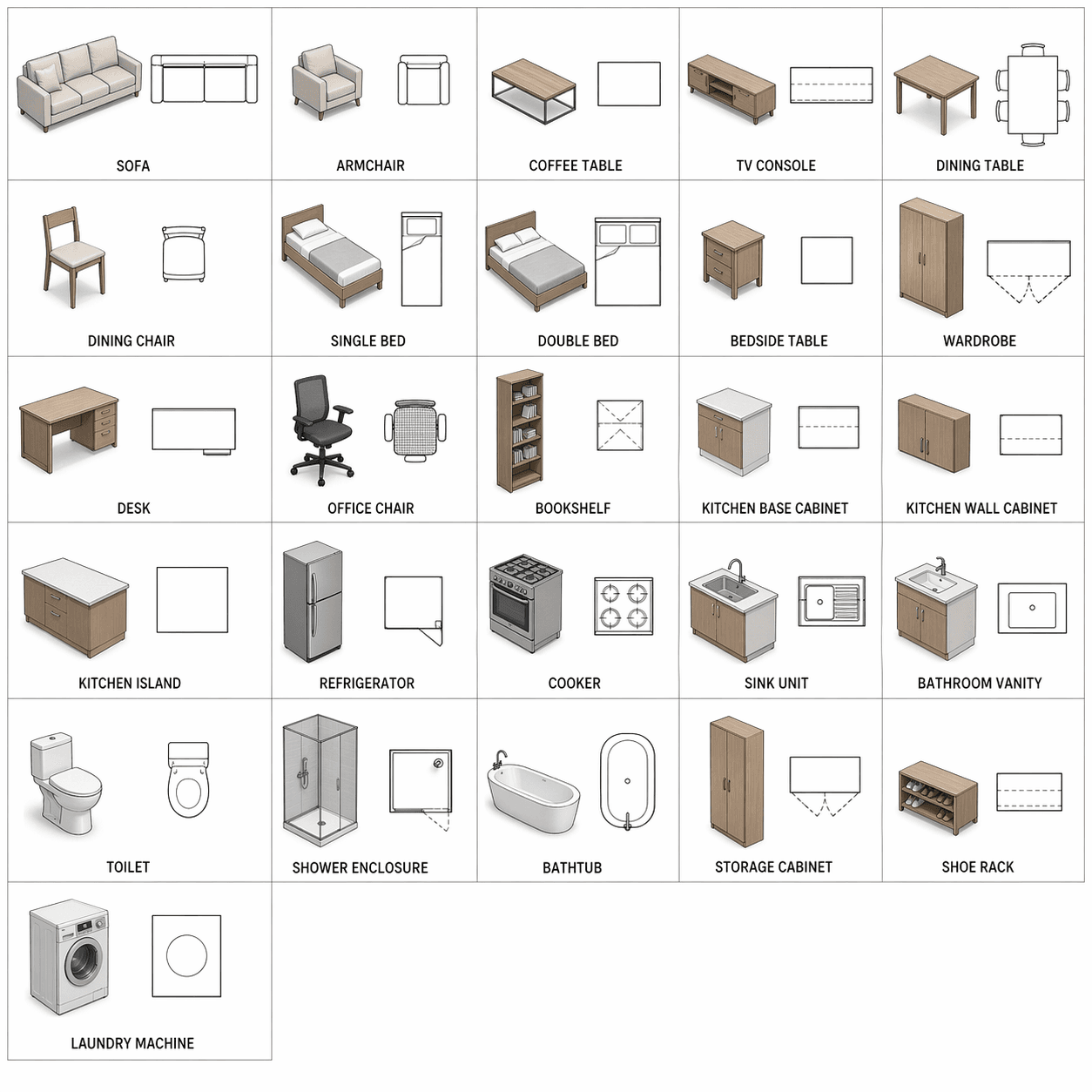
In the living room, a typical three-seat sofa usually ranges between 1800 mm and 2400 mm in length and 800 mm to 1000 mm in depth. A two-seat sofa commonly ranges between 1400 mm and 1800 mm in length. Armchairs often measure 700 mm to 1000 mm in width. Coffee tables typically range from 600 mm to 1200 mm in length and 400 mm to 700 mm in width, while side tables are usually 400 mm to 600 mm wide.
In the dining area, a four-seat dining table is commonly about 800 mm to 900 mm wide and 1200 mm to 1400 mm long. A six-seat table is often 900 mm to 1000 mm wide and 1600 mm to 2000 mm long, while eight-seat tables may reach 2000 mm to 2400 mm in length. Dining chairs generally require 450 mm to 550 mm per seat width, and circulation clearance behind chairs should usually be 750 mm to 900 mm.
In bedrooms, single beds commonly measure around 900 mm × 1900 mm or 1000 mm × 2000 mm. Double beds are typically about 1350 mm × 1900 mm, queen-size beds about 1500 mm to 1600 mm × 2000 mm, and king-size beds about 1800 mm to 2000 mm × 2000 mm. Wardrobes are usually about 600 mm deep for hanging clothes. Circulation beside beds should ideally be 700 mm to 900 mm where space allows.
In the kitchen, base cabinets are typically 550 mm to 600 mm deep, while wall cabinets are often 300 mm to 350 mm deep. Countertops usually have heights between 800 mm and 900 mm. Kitchen islands commonly range from 800 mm to 1200 mm in width and 1500 mm to 3000 mm in length depending on function and available space.
In bathrooms, vanity units often range between 500 mm and 1200 mm in width with depths of about 450 mm to 600 mm. Storage cabinets are generally shallower to maintain circulation comfort.
In home offices or study areas, desks commonly range from 1000 mm to 1800 mm in width and 500 mm to 800 mm in depth. Bookshelves typically range between 250 mm and 350 mm in depth depending on storage needs.
At the entrance, console tables are usually 300 mm to 450 mm deep, while benches often range between 400 mm and 500 mm in depth and 900 mm to 1500 mm in length.
These dimensions serve as reliable planning references when organizing residential interiors, ensuring that furniture placement supports comfortable movement, functional storage, and balanced room proportions.
How an Interior Plan Should Actually Be Designed
During preliminary design stages and sketching, the correct design process is not to draw walls first and then try to force furniture into the leftover spaces. A stronger process begins with zoning. Then room relationships are tested. Then furniture layouts are studied. Then circulation, door swings, windows, and storage are checked. After that, daylight, ventilation, acoustics, and safety can be refined. This method produces rooms that are truly usable.
Furniture should be drawn early because furniture reveals the truth about space. A bedroom may look fine until the bed and wardrobe are shown. A dining room may look generous until chair pull-out is considered. A corridor may appear acceptable until the doors begin to open into it. A kitchen may seem large until the work triangle and appliances are tested. Planning becomes powerful when the designer stops drawing empty boxes and starts designing for actual life.
Conclusion
Residential interior space planning is one of the deepest foundations of residential architecture because it shapes how the house is truly lived. It organizes the home into coherent public, private, and service zones. It studies each room carefully. It coordinates circulation, furniture, storage, light, ventilation, sound control, openings, privacy, accessibility, and safety. It prepares the house not only for present use but also for long-term adaptation.
A strong house plan is not explained by decoration. It is explained by order, comfort, and good judgment. When the entrance feels proper, the living room works naturally, the dining room serves daily life, the kitchen supports real workflow, the bedrooms protect rest, the bathrooms function comfortably, the stair feels safe, the openings bring in light and air properly, and all the rooms relate well to one another, the interior becomes intuitive and satisfying. That is the goal of professional residential interior space planning.